

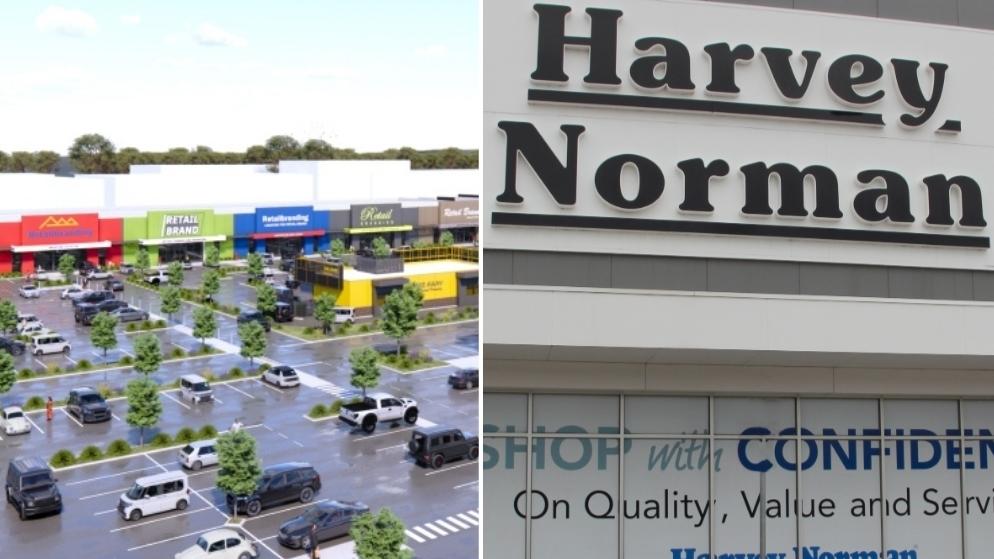

Harvey Norman will anchor Wangaratta’s new Woolstores retail precinct, aimed at keeping more local shopping dollars from leaking to rival regional hubs.
Retail giant Harvey Norman will anchor a major new Wangaratta shopping precinct aimed at stopping more household spending leaking to rival regional hubs.
The national retailer has committed to a 5000sq m store at the city’s historic Woollen Mills site, which will be reborn as the Wangaratta Woolstores large-format retail precinct.
Large-format retail expenditure within the main trade area totalled $277.5m in 2024 and is forecast to reach $441m by 2036, with the new precinct designed to capture more of that spend locally.
RELATED: Costco wins approval for $74m Melb megastore
Hidden Melb cottage reveals fairytale surprise
Buyers freeze after Labor’s budget tax hit
The development will target Wangaratta shoppers who have been leaving town for furniture, electrical goods, bedding, pet supplies, automotive products, outdoor goods and other bulky household purchases in centres such as Shepparton, Albury and Wodonga.
The former Wangaratta Woollen Mills was not just another industrial site, with the mill officially starting production in 1923 before becoming Australia’s largest mainland woollen mill.
At its peak in the early 1970s, the mill employed about 500 people and helped shape Wangaratta’s growth, including the creation of workers’ cottages in Yarrunga and later housing estates for textile workers.
The mill also helped switch on Wangaratta’s municipal electricity in the 1920s, supplying power to the town before the State Electricity Commission took over the grid.

Wangaratta’s historic Woollen Mills site is set for a major retail rebirth, with Harvey Norman committing to a new 5000sq m store.
The site that once helped power Wangaratta is now being recast as a retail precinct designed to stop the city’s shopping dollars leaving town.
Colliers retail leasing manager Nathan Brown said the current Harvey Norman store in Wangaratta had been operating from a much smaller footprint.
“The main one which we’re tying in is furniture and electrical, which is why Harvey Norman has anchored the site,” Mr Brown said.
“There’s demand from a retail spend in the Wangaratta market.
“That’s why someone like Harvey Norman has considered upgrading their store from a small one to a big one.” =
The new Harvey Norman will not be a full metropolitan-scale store, with typical larger outlets about 7000sq m to 8000sq m.
But Mr Brown said the 5000sq m Wangaratta store had been tailored to the local market.
He said the retailer’s commitment was a “big win” for the community and would help attract other brands to the precinct.
Bedding, furniture, pets, automotive, outdoor and fast-food operators are among the categories expected to be targeted for the broader centre.
Some existing Wangaratta retailers are also understood to be looking at larger premises.

The former Wangaratta Woollen Mills, once a major industrial employer, will be transformed into a large-format retail precinct.
The Wangaratta Woolstores precinct is expected to deliver more than 15,000sq m of retail space, with showroom tenancies from 600sq m to 4000sq m.
The property was recently sold off market by Colliers Retail Middle Markets, in conjunction with local agency Garry Nash & Co Real Estate, and acquired by national developer Accord.
Accord has since appointed Colliers Retail Leasing to secure precommitments from national and regional retailers.
Mr Brown said the project’s catchment stretched beyond Wangaratta itself, with surrounding towns also expected to support the retail hub.
He said new growth areas were expected to add about 6000 people to the catchment, while towns such as Benalla could be drawn towards Wangaratta instead of Shepparton.
“If I’m in Benalla, I’m 25 minutes or something like that away from Wangaratta, where typically I might be 35 or 40 minutes to Shepparton,” Mr Brown said.
“So I’ve got a bit of a closer market now.”

The new Wangaratta Woolstores precinct is expected to target shoppers who have been travelling to Shepparton, Albury and Wodonga for big-ticket household goods.
Mr Brown said regional satellite cities had become increasingly attractive for large-format retail developers because land acquisition costs remained more reasonable than in Melbourne’s growth suburbs.
He said construction costs were broadly similar across markets, meaning lower regional land costs could help major retail projects stack up.
“Some of these locations, Wangaratta, the land cost on the acquisition for the developers is still reasonable at the moment compared to the growth suburbs of metro Melbourne,” Mr Brown said.
“Having that gateway to a smaller acquisition cost makes the development stack up.”
Wangaratta’s historic Woollen Mills site is set for a major retail rebirth, with Harvey Norman committing to a new 5000sq m store.
Colliers associate director of retail leasing Jake Beckwith said Wangaratta’s role as a regional service centre was a major driver behind the project.
“As one of regional Victoria’s established satellite cities, Wangaratta supports a broad surrounding catchment and continues to attract population growth and investment,” Mr Beckwith said.
Mr Brown said regional satellite cities had traditionally been overlooked by major brands, but were now attracting increased retailer interest as operators looked beyond metropolitan constraints.
“The Wangaratta Woolstores precinct will play a key role in meeting this demand by delivering contemporary large-format retail, reducing the need for residents to travel to Shepparton, Albury and Wodonga for bulky-goods and household purchases,” he said.
Construction is expected to begin in mid-2027, with the precinct planned to open in 2028.
Sign up to the Herald Sun Weekly Real Estate Update. Click here to get the latest Victorian property market news delivered direct to your inbox.
MORE: Wild loo roll photo sends house listing viral
Young couple wins three-way tussle for Newtown home
‘Can’t fix it’: Ch9 secret Block act emerges
david.bonaddio@news.com.au