

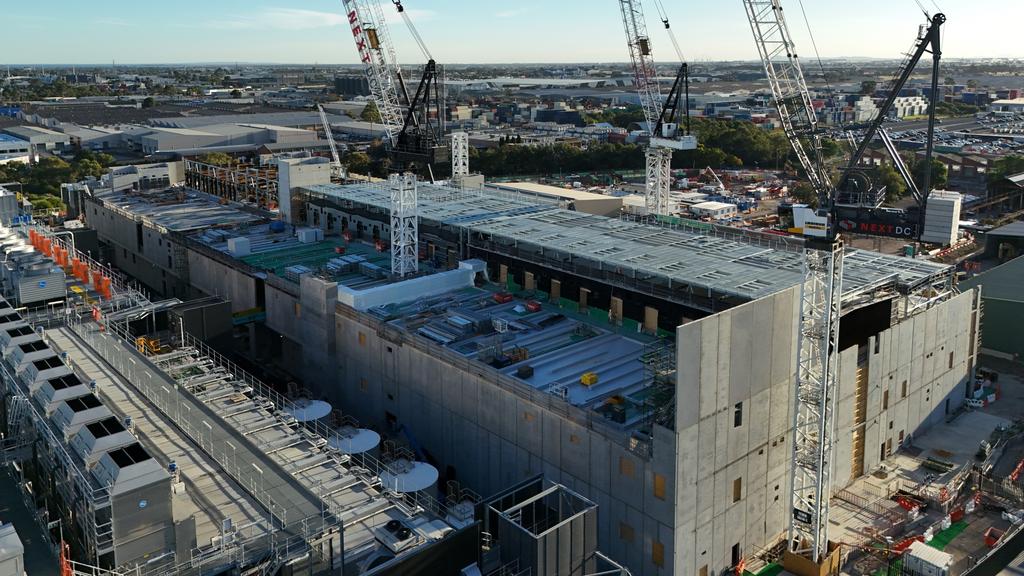

Kapitol is building NextDC’s M3 Melbourne data centre in West Footscray.
Big builders are shifting away from low-margin, high-volume work as the construction sector faces a squeeze from rising input costs and higher interest rates.
These forces have driven builders to pull back from jobs that will have more volatile returns, and they are instead chasing projects that will offer more certainty.
Hubexo APAC president Ashleigh Porter said the industry faced a permanent structural shift and called out the heightened cost of delivery driven by persistent inflation and friction in the global supply chain.
“Amidst chronic labour deficits and tightening regulatory oversight, the sector is becoming leaner and more resilient,” she said.
The firm’s annual sector rankings showed the top 50 builders commenced 722 projects this year, aligning with last year’s numbers, and the total value of those starts soared by 32 per cent to $43.9bn.
The analyst said that top builders were trading traditional, high-risk procurement systems for data-driven solutions, which has been the model adopted by top-ranked builder, Kapitol. Building apartment towers and data centres in Victoria drove its workbook.
Andrew Deveson, co-founder and director at Kapitol, said the company had sought to avoid the classic construction problem of a race to the bottom and low margins. Instead it was seeking to solve industry-wide challenges using technological solutions.
“We use AI as a core way of solving problems,” he said, with workflows automated to improve quality. While it has been challenging in the fragmented industry with complicated supply chains, he said it was an advantage.
“We’re always thinking about how to grow our business with systemic scale and repeatability,” he said. “We have taken a lot of inspiration from airline industry.”
The company is seeking to avoid the trap of lifting revenue and having profitable years before hitting problems by ensuring that it has the correct systems in place. Mr Deveson is optimistic the data-centre boom will create more apprentices and boost local manufacturing as more assets are built. “I suspect it will be a long-term asset for the country,” he said.
Builders are after large-scale and high-quality developments, which Hubexo said reflected strong underlying demand.
The top 10 firms had $22.9bn in new starts, despite breaking ground on 15 per cent fewer projects year-on-year.
Some builders had a dramatic rise, with Kapitol leapfrogging its rivals as it undertook hi-tech projects. The Melbourne-based builder commenced 17 high-value projects in 2025, exceeding $3.5bn in combined value.
The listed Lendlease, which topped the construction league in 2022, climbed to second place in this year’s edition with nine commencements valued at almost $3.3bn.
Marco Rossi’s Built secured its third consecutive top-three finish, leading the market in activity with 69 projects totalling $2.8bn.
CIMIC Group unit CPB Contractors secured fourth place with just under $2.5bn in starts, followed by the private Icon at almost $2.3bn, marking their third consecutive year as a top-10 presence.
Both ADCO Constructions and Hutchinson Builders had top-10 finishes for the fifth consecutive year. NSW-based Richard Crookes Constructions climbed to eighth, while Multiplex was ninth.
Apartment developer Deicorp rounded out the top 10 with $1.4bn in starts, a return to form as the company held that ranking in 2022 and 2023.
Hubexo said the building sector was evolving in response to shifting economic pressures and was well-placed to shape Australia’s built environment in the years ahead.