

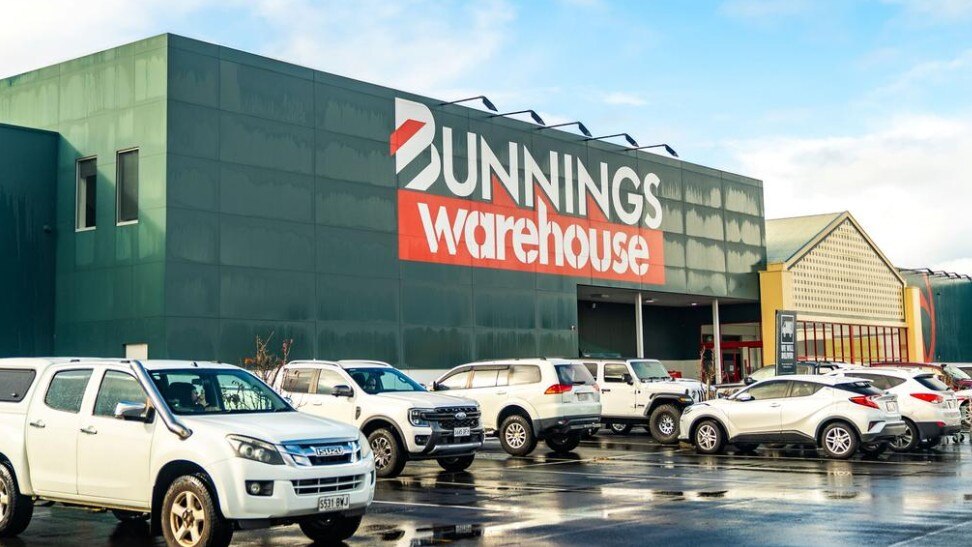
With its massive stores, endless aisles and famous sausage sizzle weekends, it’s easy to imagine Bunnings Warehouse has always dominated Australia’s hardware sector.
But it wasn’t that long ago the retail landscape was far more fragmented, offering a mix of big-box challengers, banner groups and independent networks all competing for market share.

Bunnings dominates today’s hardware landscape, but it wasn’t always this way. Picture: Supplied
From BBC Hardware to Home Hardware, many once-familiar names have been absorbed, rebranded or left behind as the economics of hardware retail shifted towards scale and price.
Here we look at the hardware chains that didn’t survive the shift.
BBC Hardware
So synonymous has Bunnings become with hardware retail that its predecessor BBC Hardware’s role as an early pioneer of the big-box format in Australia is often overlooked.
The company’s origins trace back to A.J. Benjamin & Co, a department store that opened in Chatswood in 1898, with its hardware arm operating as Benjamin’s Building Centre.

BBC Hardware was a precursor to Bunnings and has roots dating back nearly 130 years. Here’s its Gosford location in 1986. Picture: Supplied, Facebook
BBC Hardware began expanding across NSW in the 1950s, opening a second store in Broken Hill in 1953, followed by Blakehurst in Sydney’s south in 1955. Further growth through the following decades cemented its presence across metropolitan Sydney.
In 1983, Burns Philp acquired the network and rebranded it as BBC Hardware, with expansion continuing into the 1990s, including stores in Rockdale, Thornleigh and Caringbah.
The chain changed hands again in 1994, when Howard Smith Limited acquired BBC Hardware and launched the Hardwarehouse format – a spinoff positioned as a direct competitor to Bunnings.
Hardwarehouse
Backed by the existing BBC Hardware network, Hardwarehouse rapidly expanded beyond its NSW base, rolling out stores across Victoria, Queensland and South Australia throughout the late 1990s. High-profile sites in major metropolitan corridors reflected a strategy focused on scale, accessibility and destination retail.

A Hardwarehouse catalogue from 1996. Picture: Mark Nagy on LinkedIn
Despite early momentum, Hardwarehouse struggled to match Bunnings’ growing dominance and operational efficiency.
“Bunnings had the ability to offer customers an enormous product range with heavily discounted products, which Hardwarehouse struggled to match,” IBISWorld analyst Michael Doyle told realcommercial.com.au.
In 2001, Howard Smith sold the chain to Wesfarmers, which moved quickly to convert both Hardwarehouse and BBC Hardware locations into Bunnings Warehouses, effectively absorbing its closest rival and cementing its national footprint.

By the early 2000s, former Hardwarehouse sites became Bunnings, identified by the signature three flagpoles out the front. Picture: Mark Nagy on LinkedIn
Thrifty-Link Hardware & Home Hardware
Compared to the chain format, Thrifty-Link Hardware and Home Hardware operated as networks of independent retailers under shared banners, pooling buying power to compete with larger players on price and branding.
Established in the 1970s, Thrifty-Link built a strong presence across regional and outer suburban markets.
The owner-operated stores were tailored to local communities, explained retail expert Gary Mortimer.
“Like Mitre 10 and family-owned stores, Thrifty-Link offered a far more personalised alternative to larger chains like Bunnings Warehouse,” he said.

There are still a few Thrifty Links dotted around, particularly in country towns, like this one that sold in 2025, but many became Home Hardware and later Mitre 10. Picture: realcommercial.com.au
Home Hardware later emerged within the Mitre 10 system, offering similar advantages of collective buying power and marketing support while maintaining local ownership. The brand became widely recognised for its television campaigns featuring animated dog mascots Rusty and Sandy.
From the 1990s, consolidation accelerated, with many Thrifty-Link stores transitioning into Home Hardware or Mitre 10.
In 2016, both banners were acquired by Metcash in a $165 million deal, following Woolworths Group’s exit from the hardware sector after the collapse of its Masters Home Improvement venture.
The latest commercial property news
Get the latest news and insights straight to you.
Sign up
Masters Home Improvement
Designed as a premium alternative to Bunnings Warehouse, Woolworths Group teamed up with US giant Lowe’s in 2011 to launch its high-stakes hardware venture, Masters Home Improvement.
Rolling out stores rapidly across the country, Masters offered not only a hardware and home improvement range, but also whitegoods, interior design and lifestyle products.
The initial plan was to open 15 to 20 stores a year, but by 2012, reports had already emerged that the business was haemorrhaging money.

Woolworths-owned Masters attempted to enter the “under-serviced” hardware market, but closed within a few years. Picture: Getty
“Woolworths really got that one wrong,” Mr Mortimer said. “Their attempt to replicate the Bunnings model in a more upmarket fashion missed the mark and the business was recording heavy losses every year.”
“Compared to Bunnings which already secured prime store locations for its stores, Masters suffered from poor location choices,” added IBISWorld’s Michael Doyle.
By 2016, Masters had closed, with more than $3 billion reportedly spent to capture just 9% market share, according to IBISWorld data.
A duopoly or oligopoly?
Since the collapse of Masters Home Improvement, Australia’s hardware sector has been consolidated into a duopoly of Bunnings Warehouse and Mitre 10, with Mitre 10 operating more than 400 stores nationwide and Bunnings roughly 340.
While Mitre 10 technically has the larger footprint, Bunnings has the scale, generating more than 10 times the profit of the entire Mitre 10/Metcash hardware network, reporting earnings of $2.34 billion in 2025.

Mitre 10 has more stores than Bunnings, but the latter has far more scale. Picture: realcommercial.com.au
Retail expert Gary Mortimer argues the market is better described as an oligopoly, with Bunnings the clear dominant player.
“Bunnings Warehouse has a very strong trade offer that’s made hardware accessible to everyday customers; whether it’s a major project or something as simple as painting a wall. Even its grid-style layout mirrors the simplicity of a supermarket,” he said.
“This means Mitre 10 must compete differently, which they do through expert advice and local know-how. It’s a very different experience than walking into Bunnings and speaking to an 18-year-old.”
Survival of the local hardware store
So where does this duopoly – or oligopoly – leave the independent hardware store?
Retail expert Gary Mortimer believes accessibility gives local high street operators a distinct advantage over a Bunnings Warehouse.

Gary Mortimer says Bunnings is increasingly becoming a destination retailer, which isn’t always most convenient. Picture: Paul Kane/Getty Images.
“The challenge with Bunnings is you have to get in your car to get there. They’re increasingly becoming destination retailers; they offer great range and low prices, but if I just need a couple of tap washers, the convenience of buying locally will always outweigh a 30-minute drive,” he said.
“That’s where the independent ‘mum and dad’ hardware store on the high street still has a role. You’ll typically have a dominant market leader taking the bulk of revenue, while smaller players survive by fulfilling that convenience-driven value proposition.”