

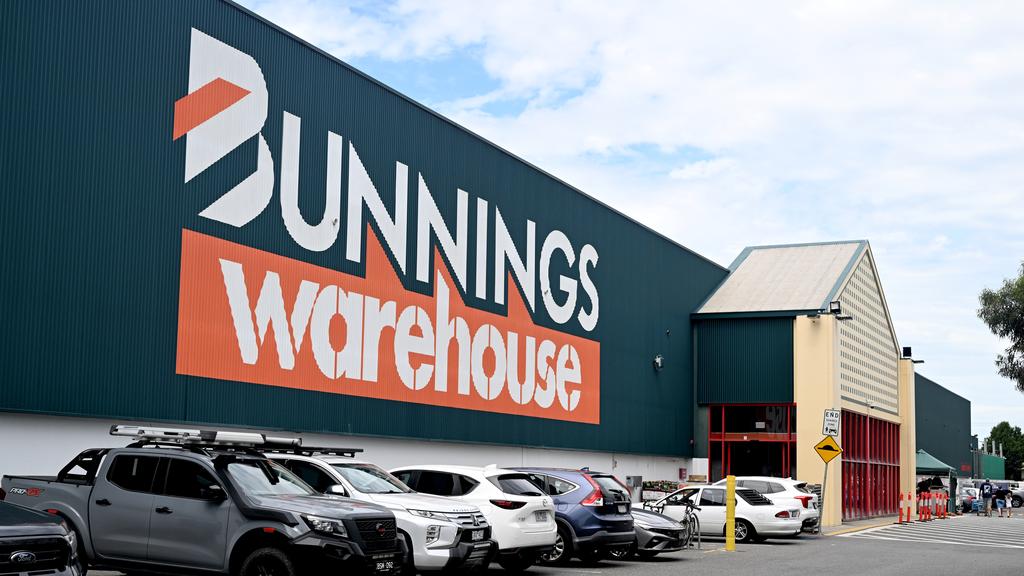

Aussie hardware giant Bunnings has just been given the green light to get even bigger. Picture: NewsWire / Andrew Henshaw
Popular giant Bunnings has swallowed two large firms whole in a mega merger – including the owner of Hard Yakka and Australia’s biggest industrial and safety supplies firm.
This after parent company Wesfarmers handed Bunnings Group control of Australia’s largest industrial and safety distributor Blackwoods as well as a national workwear empire Workwear Group which owns brands like Hard Yakka and King Gee – as well as a network of distribution centres stretching from Canningvale to Carole Park.

Bunnings will absorb WorkWear under its banner, which includes popular tradie brands Hard Yakka and King Gee. Pictured tradies Liam Austin (chainsaw), Chris Stones (grinder) and Cameron Dymock (sledge hammer). Picture: David Caird
Both companies will transition under Bunnings Group in less than a month on July 1 when the new financial year kicks off – with all brands expected to continue operating under their own names for now.
Blackwoods is not a small bolt-on, operating six national distribution centres – in Canningvale, Regency Park, Scoresby, Greystanes, Carole Park, and Mackay – as well as more than 45 branches across metropolitan, regional and remote Australia.
Its Canningvale facility alone is serious industrial real estate, running to 13,500 square metres of purpose-built distribution space.
Workwear Group brings its own warehousing, design, and distribution infrastructure to the table, covering eight brands including NNT Uniforms, Hard Yakka and King Fee plus a customer base that spans every tradie, construction crew and government department that needs a uniform and a steel-capped boot.
Bunnings is already one of Australia’s largest single-tenant occupiers, with 312 stores nationwide, controlling tens of thousands of square metres of large-format retail space.
The additional distribution and supply chain resources are set to give it unprecedented leverage across retail, industrial, logistics and last-mile fulfilment real estate.

Bunnings has become a weekend institution for many Aussies including its famous sausage sizzle. Picture: NewsWire / Andrew Henshaw
Wesfarmers chief financial officer Anthony Gianotti said the decision was made to boost shareholder value.
“Blackwoods and Workwear Group hold market-leading positions and have continued to grow share following the successful implementation of Blackwoods enterprise resource planning (ERP) system and the simplification and reset of their operating models last financial year,” he said.
“With this transition, we see a significant opportunity to leverage greater scale and capabilities to further enhance the customer experience.”
He said working more closely with Bunnings would unlock growth in the small and medium sized customer segments.
Bunnings managing director Mike Schneider said the transition would give greater access to Blackwoods’ extensive product range and national fulfilment capabilities.
“Customers will have more choice, better product availability and an enhanced customer experience.”

A WorkWear composite celebrating 100 years of King Gee. Source: WorkWear.
The man who quietly built the machine that Bunnings just inherited is walking out the door when the transition goes through. Tim Bult joined Wesfarmers in 1999 – when most of today’s tradie customers were still in primary school – and spent 27 years shaping some of the biggest moments in Australian corporate history. He helped steer the demerger of Coles in 2018, oversaw the sale of Coregas, and then spent his final chapter doing something characteristically unglamorous: sitting in rooms with Bunnings figuring out exactly how to hand over everything he built. With that work done, he is retiring in July.
Mr Gianotti said Mr Bult was “instrumental in the growth and success of the group”.
“Tim has the gratitude and best wishes of the Wesfarmers board, leadership team and the broader group,” he said.