

New data shows commercial property yields across many locations and asset classes are tightening as capital growth returns, though investors are now looking to defensive assets to shield from volatility.
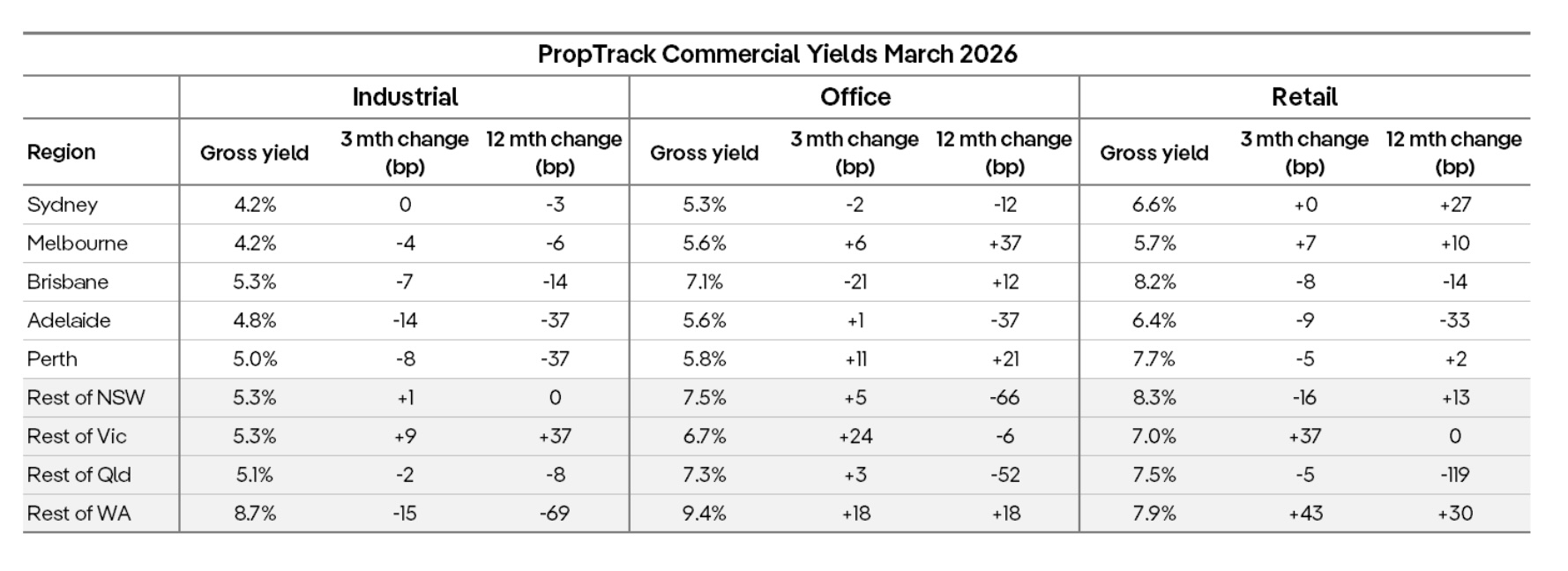
The PropTrack commercial yields report, released Thursday, measured three asset classes – industrial, office, and retail – using known sales or rentals recorded over the past 12 months.
PropTrack senior economist Anne Flaherty said the broad-based yield compression is likely due to the strong value gains seen over the past 12 months.
“Sales of commercial properties bounced back in 2025, supported by three interest rate cuts and a recovery in investor sentiment,” she said.
This is generally reflected in research by major brokers such as Ray White and CBRE.

Yields are compressing across many locations and sectors. Picture: PropTrack
PropTrack data showed industrial yields recorded the strongest compression nationally over the past 12 months, down in every capital city. Perth and Adelaide recorded the strongest falls, down 37 basis points compared to 12 months ago.
Office yields were a mixed bag with yields down in Sydney and Adelaide, but higher in every other capital city. Melbourne saw yields increase 37 basis points, which Ms Flaherty attributed to softening values and higher vacancy rates.

REA Group senior economist Anne Flaherty.
Adelaide was particularly robust, according to Ms Flaherty.
“Adelaide is notable for having the most significant declines in yields across the three asset types over past 12 months as well as past five years,” she said.
“In part, this is likely due to the abolishment of stamp duty on commercial property transactions which came into effect in 2018, but it also mirrors the growing demand to invest in Adelaide, also seen for residential property.”
The latest commercial property news
Get the latest news and insights straight to you.
Sign up
Brisbane a paradoxical success
Of the three measured asset classes in PropTrack’s report, Brisbane was the frontrunner recording the highest yields.
Gross yield for industrial was 5.3%; office, 7.1%; and retail, 8.2%.
This could come as a surprise given the river city recorded pronounced yield compression over the past 12 months owing to strong capital growth.

Brisbane recorded the highest yields despite some of the strongest yield compression over the past 12 months. Picture: Supplied
Ms Flaherty said Brisbane is emerging from the shadows of its bigger east coast city brothers.
“I think it shows opportunity, especially given the yields are so much higher than the other capitals. Historically Brisbane is perceived as a riskier market because the economy isn’t as diverse as Melbourne and Sydney,” she said.
Defensive assets in the spotlight
Ms Flaherty said the current run of compressed yields could be partially unwound due to market volatility from RBA interest rate rises, and the cost of living crunch.
A CBRE portfolio auction event this week highlighted the popularity of defensive assets such as core retail, healthcare, and big-name fast food.
Over the two-day event, $93.46 million traded hands with an average yield of 5.45% and a success rate of 89%.
A Brisbane event held on Thursday also boosted that figure to $130 million.

The 7-Eleven at 86 Church Street in Richmond was sold recently. Picture: realcommercial.com.au
“Historically, during global economic uncertainty as seen by the GFC and the pandemic, investors turn to bricks and mortar,” said Matthew Wright, CBRE senior director.
“Defensive property assets have never been more sought after; in today’s economic climate, investors are prioritising stability, reliable income, and long-term resilience above all else.”
The 7-Eleven at 86 Church Street in Richmond, Victoria, for example, sold for $3.62 million at a yield of 4.96%.
Abano Healthcare in Leopold, near Geelong, sold for $1.654 million with a yield of 5.22%.
An El Jannah in Bayswater North sold for $3.31 million on a 4.82% yield, while a KFC in Dalyellup in WA sold prior to auction for $5.45 million with returns of 4.18%.
Other sales around the country included a Terry White Chemmart, an IGA, and an Eco Laundry.
Different ways to manage risk and volatility
Investors are increasingly looking to indirectly invest in commercial assets to manage risk and diversify.
Scott O’Neill, chief executive of commercial buyers’ agency Rethink, told realcommercial.com.au that investor hesitation in direct investments is “completely understandable” and “worth acknowledging”.

Scott O’Neill, chief executive at Rethink Group. Picture: Supplied
“Diversification across asset classes within commercial property is the most practical risk management tool available. Spreading exposure across industrial, retail, medical, and where appropriate funds or syndicates means no single vacancy, lease expiry, or sector correction has a disproportionate impact on your overall position,” Mr O’Neill said.
“The consistent pattern we see is that well structured funds and syndicates with quality underlying assets and experienced management have strong demand from investors.
“The trade off is less control and liquidity, but for the right investor the pooled structure and professional management can produce very strong risk adjusted returns.”
The buyers’ agency’s capital arm has recently launched its first two public syndicates worth $27 million and $35.8 million, with the former focused on industrial assets and the latter on retail.