

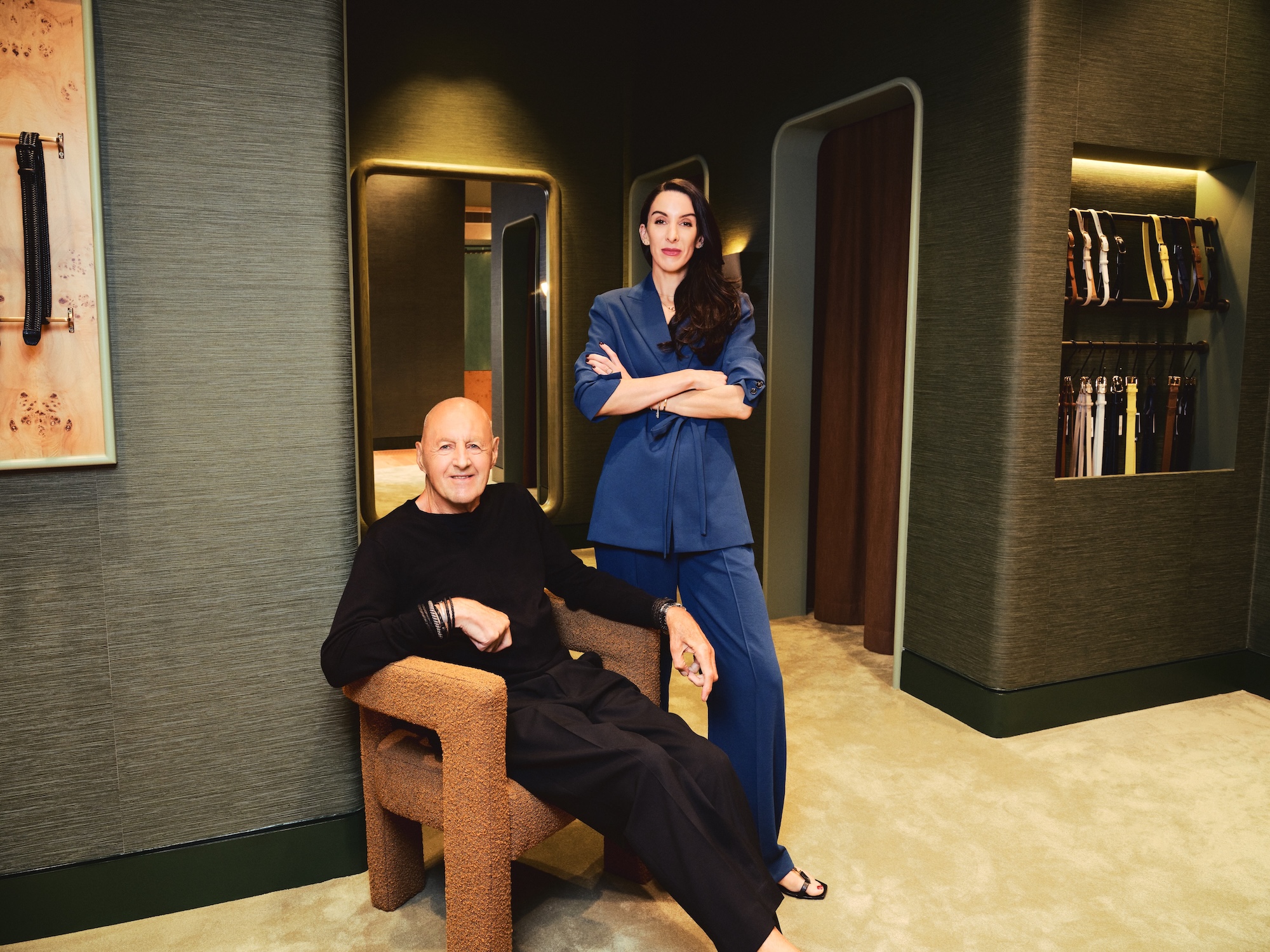
Heritage fashion brand Saba marks its 60th anniversary in retail – a milestone not many get to savour – and while founder, Joe Saba sold the business in 2002, he’s opened up the archives of his iconic designs from the ‘90s to get a nostalgic re-run.
“A journalist once described me as ‘Our Armani’ because I taught Australians how to wear black,” Joe Saba himself said. “It was the ’90s – business was great, people loved dressing-up, they embraced tailoring.”
Saba Australia general manager Lucinda Grice said it was great timing to bring back the ’90s.
“The timing for ‘90s nostalgia right now is serendipitous; we’re reliving these moments by bringing some of Joe’s original designs back in the collection,” she said.
“I have been lucky enough to go through Joe’s personal archives with him and his wife Marita in their home, and what struck me is how timeless the brand is. That has been key to its longevity.
“The 60th anniversary is proof there is still so much love and connection for the brand.”

Joe Saba and general manager Lucinda Grice. Picture: Supplied
Joe Saba’s trade dates back to 1965 with humble beginnings as a men’s business shirt outfitter.
The heritage pull of the brand is what has kept it good stead. It’s currently owned by APG & Co which also owns Sportscraft and Jag.
“The DNA that Joe instilled around quality and value for the customer is what still drives Saba today, and that’s why we’ve been able to grow as a business,” Ms Grice said.
“Our customer stays with us from university right through to the boardroom.”
Serena Gallagher, head of buying and planning at Saba, says customer come back to Saba because they trust the brand.
“Customers know if they buy a jacket or a pair of trousers, it’s going to be well made, hold its shape and work across different parts of their life,” she said.
“Our head of global quality, Kathy Gye, always says you only every know the true value of a suit when you pull it out of your wardrobe in 10 years’ time.”

Saba’s Queen Victoria Building location in Sydney. Picture: Supplied
No plans of slowing down
It’s been a busy 12 months at Saba, with five new stores opening in Australia, and five refurbishments including the QVB flagship in Sydney and Melbourne, with Chadstone due for a makeover with interior designers Arent & Pyke this year.
There’s also plans to open three more Saba stores in as many years. Overall there’s 21 freestanding Saba stores across Australia, with a presence in 40 David Jones locations across men’s and women’s collections.
“It’s great to be in a position to be able to continue to invest in the portfolio of fashion, and it’s a momentum we’ve been able to build on and keep going which is testament to the brand’s strong heritage,” Ms Grice said.

Saba’s re-modelled retail store in Canberra. Picture: Supplied
Saba’s history: Building a legacy in Australian fashion
Joe Saba’s rag trade beginnings date back to 1965 – when he opened his first store on Flinders Lane in Melbourne with a sole focus on business shirting. He would go on to open two more stores within 12 months, introducing denim and a new retail store, The Stag Shoppe.
Back then, Flinders Lane attracted long queues and security guards who were hired to control the crowds all chasing Saba’s Staggers brand in 1969. He firmly put denim on the streets of Melbourne, inspired by London’s beat generation.
His iconic ‘70s jeans can fetch upward of $200 for a pre-loved pair on eBay.

Saba’s looks from the 1980s. Picture: Supplied
The pioneering designer, went on to become known for his timeless classicism and minimalist silhouettes, with black at the core of Saba’s sartorial mission.
By 1974, he opened his first women’s store – stocking his own label and international brands with a celebrity clientele that included Tina Turner, Grace Jones and Rod Stewart whenever they came to town.
By the 1980s, he introduced Australian made garments; importing only 15% of fashion brands into his stores – and then came his commercial expansion across the country.
The the ‘90s Saba footprint included stores in Sydney – three opened in 1994 alone – Perth, Brisbane, and a flagship store on Collins Street Melbourne became its southern state hallmark.
Suffering a heart attack in the late 90s is the reason Saba scaled back his workload. He was honoured with an Australian Fashion Menswear Award, and inducted as the Powerhouse Museum’s Fashion House of the Year and honoured with an Australian Stamp in 2005.