

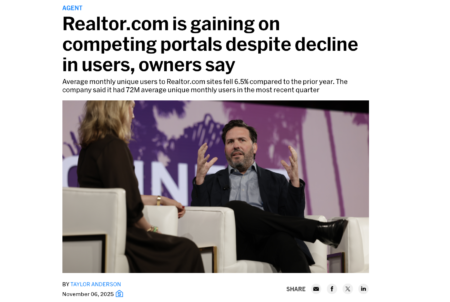
Damian Eales doesn’t want to talk about upcoming features from Realtor.com. At least not right away.
The portal’s owners recently unveiled that Realtor.com is growing its revenue, in part by leaning into premium features that it sells to its real estate professional customers.
TAKE THE INMAN INTEL SURVEY FOR NOVEMBER
When given the chance to talk about those and new features that might be coming, Eales deflected.
“The mere fact that you guys and all the others in the industry, you still just take Homes.com’s audience number, and they say, ‘Come and spend money and we’ll boost your listing to a hundred million Americans.’ But you never call out the fact that they’re aggregating,” Eales said recently in an exclusive interview with Inman.
The ensuing conversation highlighted the importance of audience size, quality and market share among the real estate portals, one of the most competitive and fought over segments of the industry to date.
Realtor.com competes with Zillow, Homes.com and Redfin for audience attention and converting that attention into high-quality consumer leads. But the media coverage of Realtor.com has not been fair or accurate, Eales said, keeping the focus on an ongoing battle between residential search portals.
Eales ultimately spoke with Inman about his strategy to build an audience, and who his serious competitors are. The following is a version of Eales’ conversation with Inman that has been edited for clarity and length. This is the first of a two-part interview.
Inman: I covered the latest earnings. So I know the strategy for News Corps and for Realtor.com is premium products for agent customers. Are there more features, new features coming down the pike?
Eales: We can talk about that. Just on the coverage of the earnings though, I’m surprised you led with the declining audience. You said we declined in market share. That’s not true. We lost some audience, that’s not market share.
The point I’m trying to make is to measure market share, you’ve got to go to an independent measure that is consistent. You can choose whichever measure you want. You can choose Comscore, which is what the advertising industry of America uses. You can choose Nielsen. You can choose Semrush. All of those will show you a market share comparison.
So the truth of it is that we have maintained unique user market share. Over the same period of time a company like Homes.com, which home-brews its metrics, […] their home brewed metrics have declined in unique user audience share on those metrics.
We look at pageviews because it’s a better measure of engagement — because you can start to then calculate how engaged people are, or do they bounce?
We’ve closed 50 percent of the audience gap with Zillow over the last 12 months. It’s a huge market share gain in terms of audience.
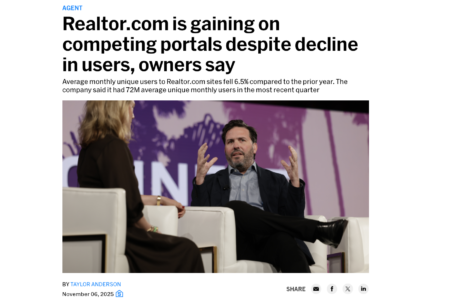
Not to nitpick, I don’t remember using the term market share.
I think the headline should have been ‘Realtor.com revenue grew faster than Zillow on a like-for-like basis.’ We don’t have mortgage, and it grew faster than the REA Group in Australia. It’s the fourth consecutive quarter of revenue growth. When I read your article, I thought to myself, ‘This is a pretty negative take on the most positive result Realtor.com has literally had in the two and a half years of being here.’
The mere fact that you guys and all the others in the industry, you still just take Homes.com’s audience number, and they say come and spend money and we’ll boost your listing to a hundred million Americans.
But you never call out the fact that they’re aggregating. They’re aggregating 17 different websites in that. I challenge you to go on Land.com and find any of the people’s listings. They’re not there. I challenge you to go on Apartments.com and find a Realtor who is boosting their listing.
Zillow also aggregates every listing. Rentals, etc.
But hang on a tick. It’s very different. I’m not here to defend Zillow. But it is very, very different. The rentals are on the Zillow URL. And Zillow has the capability — as we do — to encourage renters to buy. So it’s a toggle. And renters do, they look at both.
So what’s the scoreboard? Because this seems like it’s everything.
What’s the scoreboard? You know, it’s funny. Everything does start with an audience. So it’s important, but it’s not the be-all end-all, to be honest. It is a good scoreboard. We use it in our business.
But if it’s the only measure it can be gamed. And the way you game it is you buy a lot of low-cost traffic to artificially inflate that number, and it doesn’t turn into benefit for clients. So it’s a dangerous single metric, if you know what I mean.
Audience is one metric, but quality is really what we’re interested in. So, highly engaged audience, people who are looking to buy a home.
Homes.com seems to be focused on Zillow, rather than Realtor.com. Whereas you are focused on Homes. I don’t hear you talk about Zillow as much.
The truth of the matter is if you look at last August Comscore data, we’re four times their pageviews, 4x.
Then why aren’t you reaching at Zillow like Andy [Florance] is? Like CoStar is.
We’re very competitive against Zillow. But a couple of things. I don’t think that it’s a zero-sum game. There is a lot of upside for the portals to make homebuying more efficient. I don’t think it necessarily comes from one portal to another. I think that there’s more benefit that we can provide.
Me trashing Zillow I don’t think is necessarily in the interests of what our customers want from us. Our customers just want a high-quality conversation with somebody who’s ready to buy or sell a home. I think it’s far more in the interest of my customers to just put our head down and focus on delivering that.
I guess that’s just the Zillow style as well.
I’ll just add that the reason we came out against Homes.com is that they were being deceptive and misleading and they were being defamatory to our brand. Zillow doesn’t do that.
I think that Homes.com is a lot less relevant to us. They’re very small. They’re one quarter of our pageview audience on an independent measure last August. They are not growing substantially at all in terms of their business performance despite an extraordinary investment. They’re not moving the dial. So we’re far more focused on Zillow and Rocket-Redfin as serious competitors.
Email Taylor Anderson