

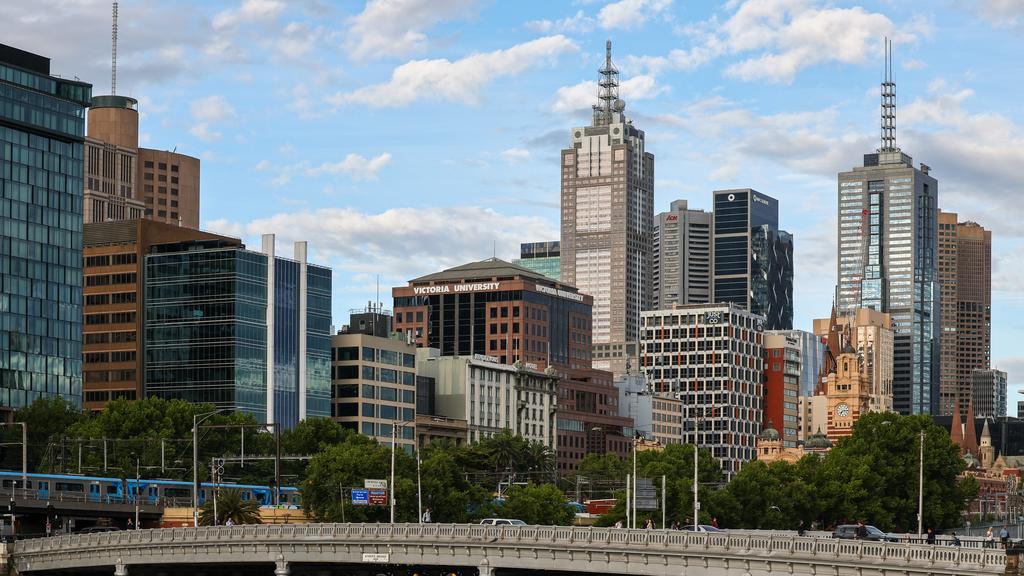
Melbourne office yields have recorded the largest correction of any capital city. Picture: Jason Edwards
The office market has long been viewed as one of the more desirable commercial asset types, with prime grade towers, blue-chip tenants and long leases justifying sharp pricing and low yields.
But the sector has struggled in recent years. Remote and hybrid working have reduced space requirements, vacancies have surged and, at the same time, the overall size of the office market has seen a rapid expansion.
This has created increased risk for office asset owners and led to repricing. Nowhere has the adjustment in pricing been more pronounced than in Melbourne.
Realcommercial.com.au’s March 2026 Commercial Yield Report shows that Melbourne office yields have recorded the largest correction of any capital city, rising 37 basis points year-on-year to 5.6 per cent.
Yields also softened in Perth and Brisbane over the same period, expanding by 21bps and 12bps, respectively.
Sydney was one of only two markets to have yields move lower over the past year, compressing by 12bps. Adelaide was by far the strongest performer year-on-year, with yields sharpening by 37bps.
As of March, Adelaide has overtaken Melbourne to boast the second-lowest office yields of any capital city, with only Sydney’s sitting lower. This divergence yield movements reveal how differently investors are assessing risk across the country, and vacancy is at the heart of it.
Nationally, vacancy is now at 15.9 per cent, the highest level seen since 1995, according to the Property Council of Australia’s January 2026 Office Market Report. Office vacancy rates are now sitting in the double-digits in every capital city bar Hobart.
Nowhere has the rise in vacancy been more pronounced than in Melbourne. In January 2020, Melbourne boasted the lowest office vacancy of any CBD market, with just 3.2 per cent of space sitting vacant. Since that time, the vacancy rate has increased six-fold, hitting 19 per cent in January this year.
It is a similar story in Sydney, where the vacancy rate rose from 3.9 per cent to 13.8 per cent between January 2020 and January 2026.
These numbers reveal a sector under considerable stress. High vacancy rates are a key predictor of rent growth and, in recent years, rent performance has been subdued.
During the pandemic, office rents took a severe hit, with net effective rents only returning to their 2019 pre-pandemic levels in the second half of 2025. But while higher vacancy rates imply decreased demand for office space, this is not the full story. In fact, six of the eight capital cities recorded positive net tenant demand over the six months to January 31.
Surprisingly, it was Melbourne that recorded the strongest rise in net tenant demand over the six months to January 31, despite overall vacancy rising from 17.9 per cent to 19 per cent over the same period.
This is because over this time about 100,000sq m of new office space was completed in the Melbourne CBD, far outpacing the growth in net tenant demand.
Elevated vacancy has shifted the bargaining power firmly to tenants, enabling them to negotiate higher incentives, reduced rents and more flexible lease terms. For office landlords, this has weakened income certainty and placed downward pressure on asset values.
Yields are the market’s mechanism for pricing that risk. The significant expansion in Melbourne’s office yields over the past 12 months illustrates a recalibration of values by investors, factoring in sustained vacancy and slower rent growth.
But Melbourne’s sharp yield correction does not necessarily signal a structural reset in valuations. Demand to lease office space has improved and absorption is strengthening.
However, development has outpaced recovery and vacancy remains elevated. Until that imbalance is resolved, investors will continue to demand higher risk premiums, and yields are likely to move even higher.
Anne Flaherty is a senior economist at REA Group.