

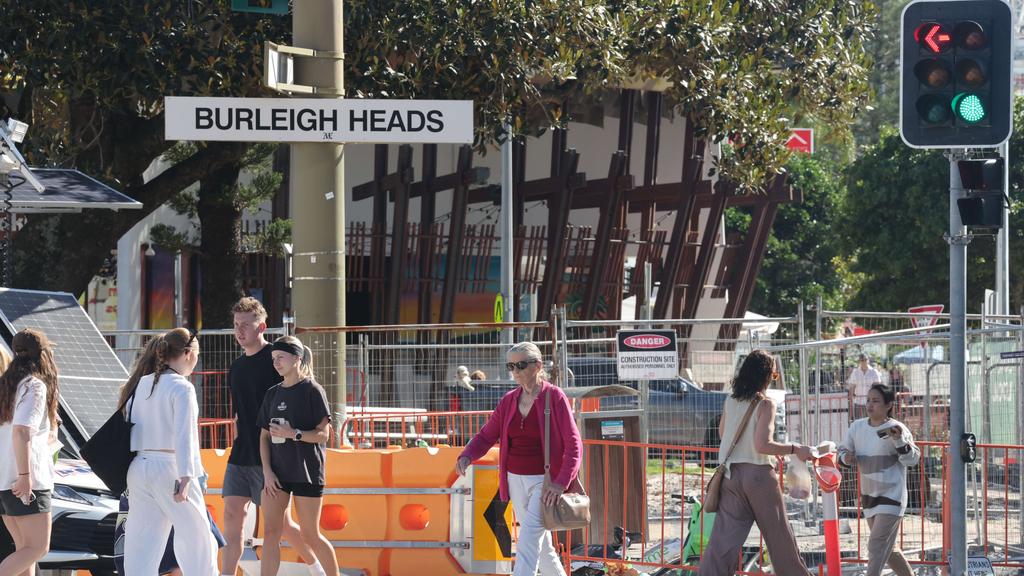
Construction is running at record levels but the war could pose threats to the industry. Picture Glenn Hampson.
The building sector hovered around record levels last year as total activity hit $318bn, amid a surge in investment in energy infrastructure, data centres and apartments, according to the Rider Levett Bucknall’s latest construction market update.
However, the industry’s strong performance is under threat from forces ranging from rising costs to uncertainty that has hit since conflict in the Middle East broke out.
The troubles have also slowed commercial deal-making across Australia as players reassess risks.
RLB warned that geopolitical risks could further add to emerging cost pressures, with conflict in Iran and the Middle East potentially increasing construction input costs via higher oil and freight prices.
Disruptions and delays to shipping routes may also raise prices for materials such as diesel, bitumen, steel and cement.
“The Middle East conflict introduces upside risk to construction costs and increases the potential for delays, although it is too early to quantify the magnitude,” RLB Oceania director of research and development Oliver Nichols.
He said if the conflict was short‑lived and oil prices retreated, the overall impact on construction costs was likely to be limited.
The most immediate channel is via higher oil prices as about 20 per cent of global oil supply passes through the shuttered Strait of Hormuz. “If elevated oil prices persist, energy‑intensive and freight‑heavy inputs are likely to see further increases, including civil movements, asphalt and bitumen, followed by materials such as steel and cement,” Mr Nichols said.
Interest rates are the other big swing factor. RLB warned that if the Reserve Bank lifted the cash rate to 4.35 per cent, construction sector work done would be about $42bn lower – a 3.5 per cent dip – over the 2026-27 to 2029-30 period than on its forecast in late 2025.
RLB said cost pressures already appeared to be returning.
Building construction costs increased at an annualised rate of 4.9 per cent in the second half of 2025, while house-building costs rebounded after falling in late 2024 and early 2025.
Persistent shortages of skilled labour, affecting trades as well as engineers and construction managers, are biting. Developers also face limited competition among Tier 1 contractors on major projects, with insolvency risks still haunting the sector.
However, Mr Nichols said the national project pipeline remained strong, particularly in WA, SA and Queensland, where approvals and project starts are speeding up.
“While construction cost escalation moderated in 2025, renewed pricing pressure is emerging as large public and private projects compete for labour and contractor capacity,” he said.
RLB forecasts construction costs to rise between 4 and 6 per cent nationally in 2026, with stronger increases expected in Adelaide (5.1 per cent), Brisbane (5 per cent), Darwin (5.2 per cent), Perth (5.4 per cent) and the Gold Coast and Townsville (6 per cent).
Engineering construction has strengthened on the back of investment in solar, wind and hydro projects, alongside major water infrastructure upgrades.
Residential construction also rebounded in 2025, rising 7.3 per cent, with apartment projects accounting for much of the growth. Non-residential construction remained stable, although investment in data centres, hospitals and aged care facilities jumped.