

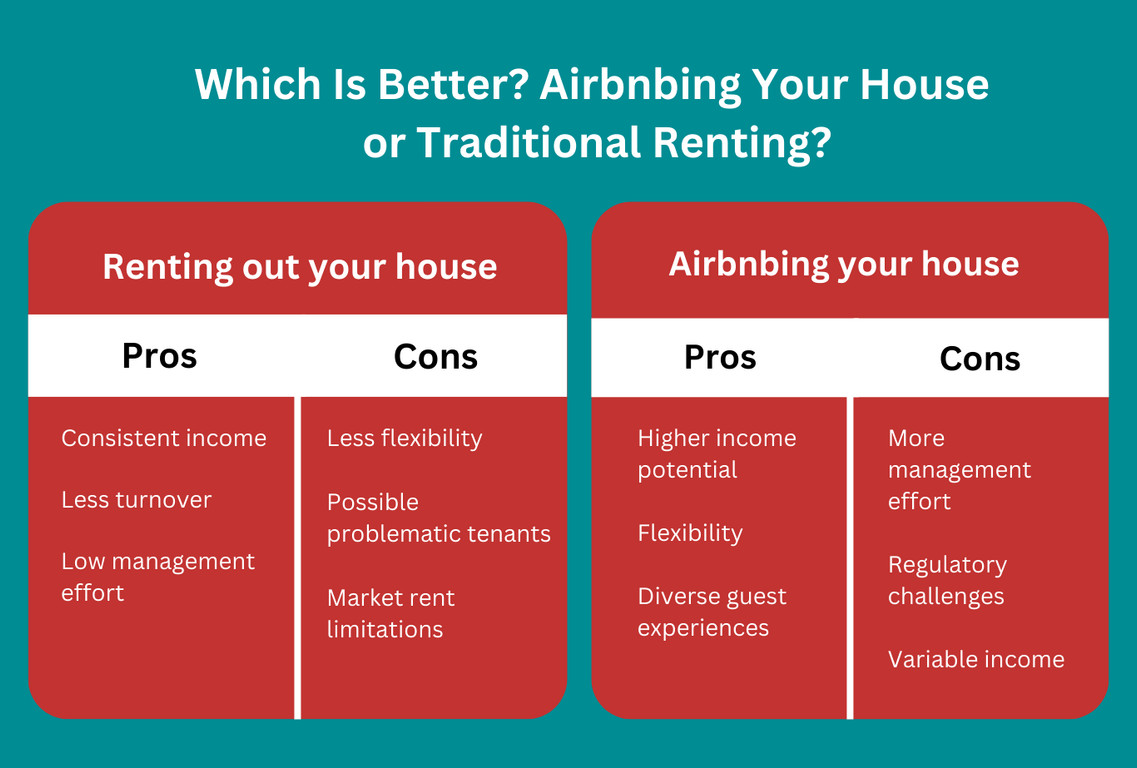
When deciding between listing your property on Airbnb or opting for a traditional rental, it’s essential to weigh the pros and cons of each approach. Whether you’re looking for flexibility, a steady income, or less management hassle, both options come with unique benefits and challenges.
In this Redfin article, we’ll explore the key factors to consider, helping you make an informed decision that aligns with your financial goals and lifestyle preferences. So, if you’re renting out your home in New Orleans or your beachfront condo in San Diego, there’s an option that works for you.

Do you want a short-term or long-term rental?
Short-term rentals, like those on Airbnb, offer flexibility and the potential for higher earnings, especially in popular locations, but require more frequent management and upkeep. On the other hand, long-term rentals provide a stable, predictable income with less turnover, but they come with longer commitments and potentially more complex tenant relationships. Understanding your goals and capacity for property management is crucial in making the right choice.
“Before choosing between Airbnb and a long-term rental, homeowners should check local short-term rental regulations, since some markets restrict or heavily tax Airbnb-style rentals,” says Ahmed Hashlamon, VP of Data at Mashvisor.
Pros of long-term rentals
Consistency
The biggest benefit of long-term rentals is consistency. You’ll have a monthly rental income, so there shouldn’t be any gaps in income. You’re able to create a consistent screening process for new renters, so hopefully no bad tenants. You’ll be able to learn about your local market to establish a competitive rental strategy and generate income.
Protection from market fluctuations
Renting your property long-term offers you protection from market fluctuations. It allows you to have a stable real estate investment strategy. When you rent long-term, you’re able to lock in a set rate for an extended period of time, which can help combat any dips in the rental market. As long as you have a lease in place, the tenant pays that rent for the whole term, even if comparable rents go down.
Reliable property value
Renting property long-term can also provide you with a more reliable property value. You’re investing for a long period of time, so it’s more likely your property will hold its value over time. Long-term rentals are also generally better for cash flow purposes. With a long-term rental, you’re able to spread the cost of your mortgage over a longer period of time, which can make it easier to manage your finances.
Cheaper overhead
When you rent your property long-term, you also tend to have lower overhead costs. This is because you don’t have to worry about the cost of advertising or the cost of turnover, both of which are significant when you’re renting short-term.
You also collect a security deposit to address issues beyond normal wear and tear – and don’t have to pay to furnish the home. These benefits don’t necessarily mean a huge profit when it comes to renting, but they can mean improved cash flow so you can begin making a little money sooner.
No seasonal fluctuations
Another big advantage of long-term rentals is that they’re not subject to seasonal fluctuations. With a long-term rental, monthly rental income is the same every month of the year, which can make budgeting easier.
Better tenant screening
Because you’re not looking for tenants who are only staying for a short period of time, you can be more selective in your screening process. This can help you avoid problem tenants and make sure that you have good, reliable renters on your property. You’re able to take the time to run proper background checks, look into credit histories, and collect references from previous landlords and current employers. You have the ability to be more selective about who you allow to live on your property.
Fewer restrictions
When it comes to local laws, long-term rentals also tend to have fewer restrictions compared to short-term rentals. There are often specific regulations and zoning laws that apply to short-term rentals that long-term rentals don’t have to follow. As a result, property management is much easier, and you may have more flexibility in how you use your property.
Cons of long-term rentals
Less flexibility
When renting your property long-term, you have less flexibility to use your property. With a year-long lease, you don’t have the option to break the lease early. There are a few times when it’s possible to break a lease, but you need to be careful. For example, you can’t end your tenant’s lease early because you want your friends to use the property.
Market fluctuations
With a long-term rental, you can’t change the rent price if you see that the rental market is getting more expensive. There are many stipulations about how much and when you can increase a tenant’s rent. You also can’t increase their rent in the middle of a lease agreement, even if costs have risen – you’ll need to wait until the lease expires.
Lease agreements
A lease agreement is a legally binding document that both you and your tenant have to sign. You’ll need to write a lease agreement that covers all aspects of renting – security deposit, maintenance, rent costs, parking addendums, eviction notices, rules, and much more. Once signed, you and the tenant have to abide by the rules outlined in the lease agreement.
Pros of short-term rentals (Airbnb)
More flexibility
As an Airbnb host, you have more flexibility when renting your property. For example, if you like to have friends and family use your property or you use the property during certain times of the year, Airbnb may make more sense. Since you can set the dates your property is available, you don’t have to worry about a long-term lease preventing you from enjoying your property.
Potential for more profit
Since your home is a short-term rental, you can change the prices during busier times of the year.
“In many markets, long-term rentals offer more stable and predictable returns, especially as short-term rentals face higher costs and stricter regulations,” says Hashlamon. “That said, well-located and professionally managed Airbnbs can still outperform long-term rentals in certain markets.”
With a long-term rental, it’s illegal to raise a tenant’s rent in the middle of their lease term. If your tenant is on a month-to-month lease you can raise the rent, but with proper notice, often 30 days in advance. With Airbnb, you have more flexibility when it comes to raising the prices. For example, you have the option to have higher prices for weekend bookings and lower prices during the week.
No lease agreement
As an Airbnb host, you don’t have to deal with creating a formal lease agreement. Airbnb has its own set of rules, in addition to the house rules included in your listing. If a guest breaks any of the rules, you can discuss the matter with Airbnb directly.
Cons of short-term rentals (Airbnb)
Although Airbnb has a “host guarantee” to protect landlords, there are still a lot of downsides to using your property for short-term rentals.
More upfront costs to you
Depending on the season, you may be able to adjust prices and bring in more Airbnb income. However, you may also have more costs associated with operating a vacation rental. Unfortunately, damages are more common in short-term rentals. You’ll also have the added cost of having to clean and restock or replace your property with certain items after each rental.
Seasonal vacancies
Airbnb hosts also face seasonal trends in the short-term rental market. Your property could sit empty a few months every year or receive minimal bookings during the off-season.
“Airbnb hosts face much higher variability in demand, with intense competition not just from other short-term rentals, but from hotels as well,” says Hashlamon. “Seasonality, pricing strategy, reviews, and location all play a much larger role in performance than with long-term rentals.”
Local laws may work against you
Some cities also limit the number of days an Airbnb rental is available, forcing you to leave your property vacant at certain times during the year.
Advertising costs
In addition to the time you’ll spend keeping your property clean and ready for guests, you’ll also put in a lot of energy to attract them. Marketing an Airbnb property requires a lot of work. You’ll have to take high-quality photos, but you should also change them each season to keep your property relevant. You’ll also have to write a compelling property description to showcase why your home is a great place to stay and what attractions are nearby.
Airbnb vs renting out your house
At the end of the day, renting your property can be a great investment, whether it’s Airbnb or renting out your house long-term. Whether you’re looking for the flexibility of a short-term rental or the stability of monthly rental payments that come with a long-term rental, there’s an option for your goals.
“Comparing short-term and long-term rental performance for the same property helps investors determine which option best fits their financial goals and risk tolerance,” Hashlamon concludes.