

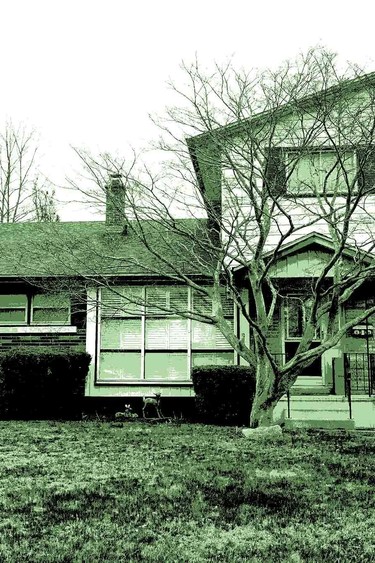
Canada’s real estate meltdown extends far beyond the major urban cores to small cities and towns like Brantford, Ont., where the dream of homeownership has proven to be a devil’s bargain for some

Article content

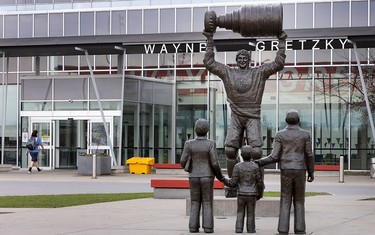
Highway 403 divides the city of Brantford, Ont., into two halves. Drivers exiting to the right can then hang another right on Walter Gretzky Blvd. and arrive at a multi-rink sports complex, distinguishable from other such complexes in other mid-sized Canadian cities by the 12-foot-high bronze cast sculpture of the Great One in the parking lot.
Article content
Article content
Those who miss the turn can continue on for a few more blocks and hang a right on Varadi Ave., notable for its unique mix of homes, generous lot sizes, proximity to parks and big-box shopping, as well as being the street where Wayne Gretzky grew up, at house No. 42 to be precise.
Advertisement 2

Article content
Article content
But Gretzky family lore was not what drew outsiders to the area in recent years; it was the “For Sale” signs on the front lawns and the promise of owning a home with a spacious lot. It was a desire partly attributed to pandemic-related big-city dread, the rise of remote work culture and generally insane housing prices in Toronto and its immediate suburbs.

Top Stories
Article content
The result was a sudden stampede of buyers who triggered an unprecedented run-up that put the average sale price of a traditional, ranch-style, Brantford bungalow close to $900,000 at the market peak in 2022 compared to a mere $300,000 or so in 2016.
Flash forward, and the average home in Brantford in February sold for $625,135, according to the Canadian Real Estate Association, a 30 per cent drop from 2022 that has saddled homeowners there with an unexpected housing crisis that Canadians across the country — everyone from bankers, realtors and debt collectors to potential buyers/sellers, renters and developers — are all too familiar with today.
For some people, what is happening now is going to be like the 1980s, when they had to hand back their keys and walk away
Brantford area realtor Cheryl Van Sickle
This is not a new crisis, but it has entered a phase where industry watchers such as Benjamin Tal and his economics team at CIBC Capital Markets are publishing papers with ominous titles, such as Canadian housing — Anatomy of a correction.
Article content
Condo prices in Toronto and Vancouver have indeed collapsed, but the real estate meltdown extends far beyond the major urban cores to the exurbs, small towns and vacation areas, where the dream of homeownership has proven to be a devil’s bargain for some.
“I have sat at kitchen tables with families who bought at the peak, and the women are crying and telling me they can no longer afford to pay their mortgages,” Cheryl Van Sickle, a long-time Brantford area realtor, said. “For some people, what is happening now is going to be like the 1980s, when they had to hand back their keys and walk away.”
At the opposite end of the disaster scenario are the wannabe buyers who did not buy and have, in theory, accumulated a war chest primed for an opportune moment to strike. What they do next was up for discussion at a recent lunch-and-learn session Van Sickle attended, hosted by one of the major banks.
A bank representative told a crowd of realtors that mortgage pre-approvals are piling up, so agents better be prepared to put on their “roller skates” since it is going to be a hectic spring.
Whether or not that turns out to be true is the million-dollar real estate question, and it has untold billions of dollars in implications for the wider economy, given that nearly half of the average Canadian household’s net worth of about $1.1 million is tied up in real estate, according to Statistics Canada data.
Article content
House prices, unlike the stock market, are “auto-correlated,” Victor Couture, an economist and professor at the University of Toronto’s Rotman School of Management, said, meaning that if prices drop one year, there is a 50 per cent chance they are going to drop the next year. In other words, he envisions further price declines in 2026.
As for when things could bounce back, he said it’s tough to say since such rebounds can be influenced by any number of things, including unforeseen events.
For example, the Bank of Canada could unexpectedly slash interest rates, the federal government could execute an about-face on immigration policy to increase annual caps on newcomers to Justin Trudeau-era levels and United States President Donald Trump could decree that the Canada-U.S.-Mexico Agreement is so good that it can remain as is.
“At the very macro level, what makes Canada most special is our proximity to the United States market,” Couture said. “We have great market access, we are well-governed, we are safe. But to take full advantage of all the global uncertainty and what makes us a safe haven is going to involve resolving our relationship with the United States.”
He has been losing plenty of sleep lately, not over the real estate market but because he has a newborn at home — a home he and his wife bought last October, more or less out of desperation.
Article content
“We needed somewhere to live,” he said. “I am not expecting the house to be a good investment, but as long as we stay here for five to 10 years, I am confident that I am not going to lose my down payment on it.”
The pandemic price increases in the suburbs and exurbs never made any sense
Victor Couture, economist at the University of Toronto’s Rotman School of Management
Others may not be so sure. At the very micro-level, the pandemic boom in real estate prices in areas outside the Greater Toronto Area (GTA) never quite added up. Love or hate the city, Toronto is a real estate unicorn since it’s where the jobs are and, due to a scarcity of land, where new, single-family homes are not being built even during the good times.
Factor in the city’s cultural attractions — pro sports teams, low-, mid- and high-end cuisine, arts, world-class hospitals and universities, street life and so on — and Toronto, outside a pandemic, is an undeniably happening place to be. All the things that make the city desirable make housing there expensive and price surges not entirely logical, but at least explainable.
Brantford, in comparison, has a giant Wayne Gretzky statue.
“It is very hard to justify why, suddenly, housing in Brantford, for example, would become a rare and speculative asset,” Couture said. “The pandemic price increases in the suburbs and exurbs never made any sense.”
Article content
In places where land is available for development, such as Brantford, housing prices should track building cost increases. Moreover, housing, in a perfect world, should be regarded as places where people live, not as potentially winning lottery tickets for Canadians looking to amass individual wealth.
Entrepreneurs, Couture said, who take risks, start companies, employ their fellow Canadians and make things people want to buy are what should drive growth and national prosperity.
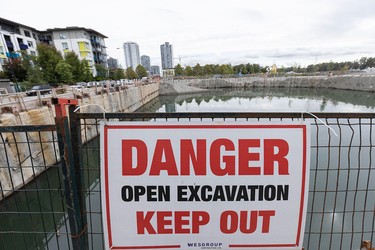
In Vancouver and areas beyond, formerly prosperous developers are among those decrying the sting of a real estate market gone sour. Beau Jarvis, chief executive of Wesgroup Properties LP, said next to nothing is getting built, and those builders who took on too much risk or simply lacked the resources to weather a downturn are now out of business.
His company is among the country’s largest, privately owned development corporations. For the first time since he signed on as a senior vice-president more than a decade ago, Wesgroup has had to lay people off and in September cancelled a 204-unit townhouse/condo project in southeast Vancouver because the economics no longer made sense.
Article content
The Vancouver suburbs are in similarly rough shape, with property owners beset by year-over-year price declines. Powell River, on the Sunshine Coast, is at the apex of real estate misery. It’s dealing with the double whammy of a pulp and paper mill closure and a real estate crash that has dropped the average year-over-year home price by 25 per cent between February 2025 and 2026.
Article content
To illustrate the scale of the pickle developers — and buyers — are in, Jarvis sketched out a hypothetical scenario. Say, his buddy, Joe Blow, came to him and said, “Beau, I need you to build me a 1,500-square-foot, three-bedroom condominium with some living space for the kids and bedrooms with enough room that you can open the closet doors without having to move the bed out of the way first.”
The cost of this imagined place, without Wesgroup pocketing a nickel, would be $2 million.
“What we are experiencing is a cost of delivery crisis, because what we’re building, no one can afford,” Jarvis said.
A decade ago, new condos on Vancouver’s east side sold for $587 a square foot, give or take, and developers made healthy margins. Jarvis today can’t sell a new condo with the same specs for less than $1,150 a square foot since he estimates red tape now accounts for 40 per cent of the per-square-foot cost of a new build.
“A significant portion of the cost is government fees, levies and taxes, development cost charges, community amenity contributions, GST, property transfer tax and additional school tax on land,” he said. “The taxation that has occurred in our industry, we often joke that it’s like a sin tax; we are taxed more than cigarettes and alcohol, and they tax cigarettes and alcohol to change behaviour.”
Article content
The 10-year average for pre-sale condos in Metro Vancouver is about 4,000 units per quarter. In the first quarter of 2026, 87 units were pre-sold, according to Jarvis. Buyers are no longer buying. Projects are not getting built. Developers are going belly-up.
But hope, if there is any, has sprung from an unlikely source: Ottawa.
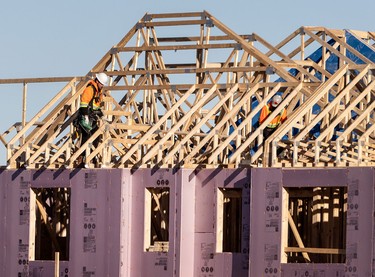
For example, the federal and Ontario governments are partnering in an $8.8-billion effort to build “more affordable homes” over the next decade. The agreement, announced at the end of March, intends to slash municipal development charges by up to 50 per cent.
Homebuyers, meanwhile, will enjoy a maximum $130,000 rebate on new homes valued up to $1.5 million. The combination of a rebate, plus lower development charges, is projected to generate an additional 8,000 new housing starts in the coming year, according to the province. Jarvis is hopeful the Ontario deal has set the stage for a similar deal in British Columbia.
Article content
Couture, in Toronto, said the changes are long overdue.
“Lowering development charges was always a no-brainer,” he said. “The economics of heavily taxing building more housing — an outcome that you wanted to see happen — was horrible.”
Back in Brantford, Rose Sicoli, the city’s deputy mayor of external relations, tells a real estate story that is not unique to her. She was born and raised in nearby Hamilton, and she moved to Brantford because homes were more affordable and the pace of life more serene. Her job outside politics was as a realtor, something her husband does as well.
Article content
Article content

Putting on her real estate hat, she describes Brantford’s price decline as “not a bubble that is popping, it is not a crash; we’re simply correcting and stabilizing from what was a completely unsustainable spike in prices that we saw a few years ago.”
Sicoli has sold a lot of homes in Gretzky’s old neighbourhood over the years, although the No. 99 factor, which is an interesting tidbit for clients, has never been a key driver in people buying. Besides, her constituents today are most concerned about the basics — the price of groceries and gas — so if there is an overarching local worry, it is not house prices, but Brantford’s rate of growth.
The city’s population grew by 12 per cent to 104,688 between 2011 and 2021. The population today is closer to 110,000. Based on city staffers’ projections, the city by 2051 could be home to 165,000 people, which in the present day would rank it among Canada’s 35 largest cities.
Some Brantfordians of the future will no doubt put down roots in what was once Van Sickle’s backyard with the “million-dollar view.” The 60-year-old moved here from England at age 14. Her career plan, to one day own a restaurant, changed course when a customer at the place she was managing told her she would be great at sales.
Article content
Just like that, a real estate player was born.
Van Sickle’s classic Brantford bungalow is set on a quarter-acre lot that backs onto a road. Up until recently, she had an unfettered view of the apple orchard beyond it, which is now in the process of being developed into 1,500 new homes.
“I used to look out at apple orchards and I actually had a moment, after they pulled out the trees, where I said, ‘God, it is all bare now,’” she said. “But I embrace the change. We need more homes being built. People need somewhere affordable to live.”
• Email: joconnor@postmedia.com
Read more from our Spring Real Estate Survival Guide
Spring is traditionally the busiest time for real estate and this year, the stakes couldn’t be higher. Follow our Spring Real Estate Survival Guide series as we unpack some of the most pressing questions buyers and sellers are grappling with, plus expert advice on how to navigate the reality of a slower market. Read the full series here.
Why timing the bottom of Canada’s roller-coaster real estate market may be harder than you think
Buying in a bear market: These dealmaking tips could save house hunters a bundle this spring
Looking for a mortgage?
The best mortgage rates in Canada right now
The best reverse mortgage rates in Canada right now
Article content