

Success in the Australian CBD used to be measured by the floor number of a glass-and-steel skyscraper. But walk through the streets of our capitals in 2026 and you’ll notice a distinct shift.
The traditional long-term lease is looking increasingly like a relic of the past as businesses — from tiny start-ups to corporate giants — flock to co-working hubs that offer something no home office can replicate: a heartbeat.
Forget the old-school dominance of sprawling, multi-level headquarters. A nimble and increasingly influential movement is underway—and it’s all about the ‘hive’. And this isn’t just a niche or fleeting trend, it’s a tangible force reshaping how Aussie businesses approach physical space, backed by a market valuation that has now soared to $1.03 billion, according to the 2026 Mordor Intelligence sector report.
“In today’s volatile market conditions, flexibility isn’t a perk. It has become a core commercial strategy, providing the agility and financial discipline businesses need to navigate rising costs and shifting market demands,” said Gareth Haver, regional CEO at International Workplace Group (IWG).
Mr Haver, who has spent over a decade helping organisations transition to more efficient real estate solutions, notes that 83% of CEOs are already empowering teams to work from multiple locations. The logic is simple: why pay for 1,000 square metres of empty air on a Tuesday when your team only needs 200?
“The days of needing to be tied to a central HQ are behind us. Technology has effectively removed the need for daily long and expensive commutes,” he said. “By operating flexible workspace solutions, companies can save around 50% on their traditional real estate costs without the burden of being stuck in long and inflexible leases.”
Beau Arfi, CEO of Maple Investment Group, notes that this flight to agility is rewriting the investment playbook.
“We’re seeing investors move away from passive buy-and-hold strategies and toward structures that prioritise cash flow resilience and execution certainty,” Mr Arfi said.
“In 2026, the margin for error has narrowed, businesses need spaces that can absorb market shifts without breaking the bank.”

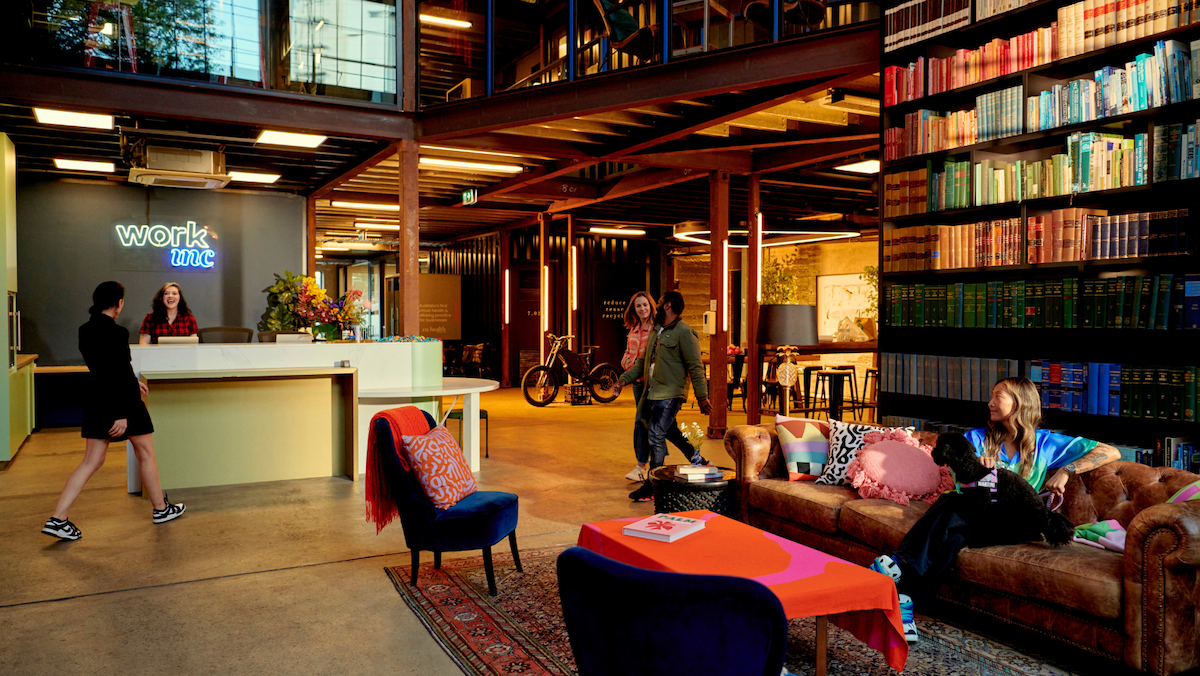
Work Inc. offers fully furnished office spaces for lease inside a heritage steelworks warehouses. Picture: Work Inc.
This lifestyle is exactly what’s on offer at sites like 6 Middlemiss Street, Lavender Bay. By transforming a series of heritage steelworks warehouses into a home for over 100 businesses, Work Inc. has created an environment where a solo entrepreneur and a multi-national team can share a strategy over the same communal table.
This isn’t just about sharing a printer; it’s about the friction of ideas that only happens when the walls come down.
The workplace as a talent magnet
The workplace is no longer just a room with desks and fluorescent lights — in 2026, it has to be a destination. If an employee is going to spend an hour on a train, the payoff has to be better than an ergonomic chair they already have at home.
Emma Davison, CEO at Virtual Headquarters, believes providers are now focused on earning the commute.
“People no longer come to the office just to sit at a desk,” she said. “They come for collaboration, connection and experiences they can’t replicate at home.
“When work is blended with lifestyle through thoughtful design and wellness-focused amenities, the office becomes something people choose, not something they’re forced into.”

30 Pirie St in Adelaide offers fully fitted out office space and best-in-class amenities. Picture: realcommercial.com.au/lease
Mr Arfi agreed that the environment is the ultimate recruitment tool. In a world of quiet quitting and the great reshuffle, the physical office has become a silent recruiter.
“Co-working spaces give businesses an environment people actually want to come into,” he said. “For employers, providing access to high-quality hubs has become a competitive advantage when attracting and retaining talent, particularly for teams that value autonomy.”
The billion-dollar profit model
But how do these spaces actually stay in the black while traditional commercial real estate faces challenges? In short, profitability now hinges on Management Agreements, whereby landlords and operators move away from traditional rent to a shared-profit model.
“The shift toward Management Agreements has redefined the risk-reward profile for landlords,” said Mr Haver. “By moving away from fixed rent to a partnership model, property owners can capture the significant upside of a high-performing flex space while operators can scale without the traditional heavy capital requirements. It’s the engine room of the industry’s $1 billion valuation.”
This is bolstered by service revenue — the monetisation of podcast studios, event spaces, and high-end meeting rooms.

Wellness facilities including onsite fitness classes are on offer at 264 George Street. Picture: realcommercial.com.au/lease
Ms Davison noted that this diversification is the key to modern commercial survival.
“Founders are far more deliberate about where they invest their capital,” she explained. “A high-performing hub provides credible CBD infrastructure—like secure mail handling and professional boardrooms—at a fraction of the cost, creating a more efficient alternative to traditional overheads.”
This creates the hive effect where large projects are viable because they create an internal ecosystem. This inter-connectivity means that it’s much harder to leave an office when your lawyer, your marketing agency, and your morning coffee are all under the same roof.
Heritage heroes and the institutional pivot
Landlords are no longer just selling space — they are selling solutions. An example is Sydney’s iconic Australia Square Tower at 264 George Street. Here, on levels 7 and 8, new premium flexible suites offer private meeting rooms and a dedicated auditorium and podcast rooms.
Meanwhile in Adelaide, 30 Pirie Street has emerged as a masterclass in worker-led architecture, resulting in a space that prioritises human biology, using high-volume ceilings and sun-drenched voids to create a performance-enhancing environment.

A bookable 100-seat Forum Amphitheatre is one of the amenities on offer at 30 Pirie Street in Adelaide. Picture: realcommercial.com.au/lease
Ms Davison highlighted such sites as the new standard: “Retaining architectural features like high ceilings and natural light creates an environment that feels far more human than a conventional office floor,” she said.
In WA, Spaces Fremantle at 135 High Street sits within the historic Manning Buildings. Built in the early 1900s, this site once housed the Majestic Theatre. Today, it demonstrates how older buildings can be reimagined to support today’s tech-driven industries while strengthening the local community.
“Melbourne and other capitals are seeing a similar shift where investors target areas where fundamentals support sustainable cash flow,” added Mr Arfi.
“It’s no longer just about the entry price; it’s about the full equation of yield resilience and the long-term delivery of a high-quality experience.”
The future of the office
As the lines between work, life, and community continue to blur, the office has shed its status as a mandatory daily grind to become a curated ecosystem. We have entered an era where the most valuable commercial assets are no longer defined by their footprint, but by their ability to foster the kind of connection that a kitchen table simply cannot provide. Now, in a world where agility is the new currency, the buildings that function as a collective hive are the ones left standing.

Spaces in Fremantle offers workspaces that scale up and move with businesses as they grow. Picture: realcommercial.com.au/lease
“The Australian market will continue to move in this direction with a workplace ecosystem that is local, flexible, sustainable, and employee-led,” said Mr Haver.
“That’s not a temporary adjustment, it’s the long-term shape of commercial property.”