

Much ink has been spilled and keyboard strokes logged over the impending budget measures.
Many outlets correctly predicted that the 50% capital gains tax (CGT) discount would be axed for some, and tweaked for others, and negative gearing – that is, offsetting investment losses against taxable income – would be big themes of the budget.
Here are several key takeaways and what they mean for commercial property investors.

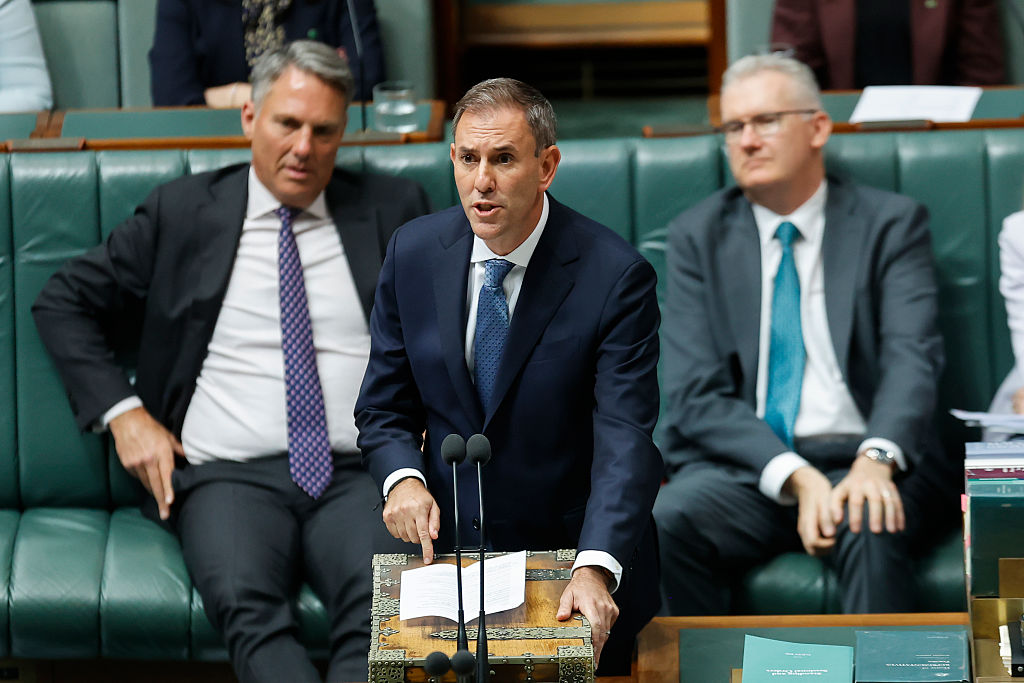
Treasurer Jim Chalmers’ Federal Budget for 2026 includes several measures tweaking the capital gains tax discount and negative gearing. Picture: Getty
Capital gains tax discount scrapping confirmed
As expected, from 1 July 2027, capital gains on assets including property is set to get a significant shake-up at tax time.
The blanket 50% discount is out for existing properties, in favour of an inflation indexation compensation model, but will be proportionately grandfathered in if assets were purchased prior to this date. This is similar to how capital gains were treated pre-1999.
Investors chasing new builds will be able to choose from the 50% discount or the new arrangements when they sell the property.
This applies to individuals, trusts and partnerships. More on trusts later.
The budget also went further than expected, introducing a minimum CGT floor of 30% – this is designed to disincentivise deferral of property sales to lower income tax periods, such as retirement. This builds redundancy into the system, limiting behavioural shifts, according to budget papers.
REA Group modelling shows – for residential property – that the new-old indexation model generally favours property investors when inflation is higher, assets are held for longer and appreciation is more modest.
This favours cities such as Melbourne, which has seen modest growth – including across commercial assets – and sees smaller cities such as Perth and Brisbane fall out of favour owing to their short, sharp appreciation in values and higher yields.
However, there is now a ceiling and natural timeline to investment with the 30% floor.
“Under these changes most residential investment properties will likely have a higher taxable gain. However, that is not true for all,” REA Group economist Luc Redman said.
“Some dwellings will benefit from this change, we estimate that over the past decade approximately 27% of properties that received a capital gain would have been better off under the indexation model over the 50% discount.”
An important carve-out is that means-tested welfare recipients such as those on JobSeeker or the Age Pension are exempt.
Assets purchased pre-1985 when there was no capital gains tax – a product of the Fraser Government – will also be proportionately affected by the changes.
REA Group also confirmed with Treasury that there’s a carve-out that exempts build-to-rent, which Mr Redman says could incentivise more commercial investors to pile capital into the space.
CGT is expected to add between $33.6 billion and $35.9 billion to government coffers every financial year for the next five financial years.

Yield compression has been an emerging theme amid market volatility.
Negative gearing is out but questions remain
Negative gearing will now be limited to new build, residential property. What’s more is that from 1 July 2027, losses will only be deductible against rental income, with excess losses able to be carried forward in subsequent tax years.
This is a step closer to following Nordic models of taxation, which tend to separate labour income from wealth.
These changes apply to property purchases made from budget night. Contracts already entered into or in limbo will largely be exempt.
Exemptions also include properties held in widely-held trusts and super funds, as well as build-to-rent developments and those investing in government housing programs – emerging commercial asset classes.
Tweaks to negative gearing are set to add $3.6 billion to government coffers over the next five financial years.
There was no explicit mention of a carve-out for commercial property.
REA Group also confirmed with Treasury that an investor’s portfolio is assessed for gearing wholistically, rather than on a property-by-property basis.

Treasurer Jim Chalmers delivered his fifth budget, and this year’s was his most ambitious. Picture: Getty
Trust the process
Discretionary trusts, as mentioned above, will be subject to a 30% minimum tax from 1 July 2028. This is designed to disincentivise the shielding of property investments to usual taxation treatment by placing them in the more opaque trust structure.
Treasury found discretionary trust levels had more than doubled over the past 20 years, with the wealthiest 10% of households holding more than 90% of the value of private trusts.
This crackdown is set to add $4.5 billion to the government’s bottom line over the next five financial years.
SMSFs and limited-recourse borrowing safe for now
In the lead-up to budget night, there was conjecture that self-managed super funds would be targeted, particularly through a crackdown on lending to residential investments.
However, there was no explicit mention of self-managed super in budget papers, with SMSF loans generally set up under a bare trust structure.
Tax office data shows leveraged investments for residential property held within SMSFs has grown considerably over the past decade, neck and neck with commercial investment.
Loans for property held within SMSFs are permitted under a limited-recourse borrowing arrangement (LRBA), which are slightly different from normal home loans that are full-recourse.
Commercial investment through SMSFs has traditionally been more popular as small business owners can operate on a buy-leaseback model – purchasing the asset they are working from, and paying rent money into the fund.
In relation to trusts, budget papers made mention that exemptions apply to “compliant” superannuation funds, ostensibly placing more onus on SMSF trustees to ensure their fund remains compliant in regards to reporting requirements.
The unanticipated behavioural shifts: Chasing yield
Budget papers recognise that changes to CGT and negative gearing are designed to incentivise investors into new builds and for units – and to disincentivise the sale of assets in retirement when income is lower.
Treasury modelling shows that for most of the past 10 years, house investors were vastly over-compensated for inflationary losses under the old CGT system, while in most years, unit investors were under-compensated.

Source: Budget Paper 1, Treasury
Treasury says this levels the playing field, estimated to support an additional 75,000 first-home buyers over the next decade.
However, REA Group senior economist Anne Flaherty says the unforeseen changes will be more flows to commercial property investment.
“The combination of changes to negative gearing and capital gains tax settings are likely to drive investors away from residential property to other investments,” Ms Flaherty said.
“Commercial property may begin to look more attractive, particularly to those seeking stronger yields and less exposure to changing housing policy.”
Real Commercial’s Q1 yields report showed while commercial yields had compressed over the past year, owing to stronger capital growth, they were still generally much higher than residential yields.
Markets such as Brisbane showed both strong yields and high capital growth relative to other cities.
“Many investors tolerate low yields when owning residential property because of the tax treatment and long-term capital growth prospects. These changes now alter that equation.
“This could drive more people to consider investing in commercial assets which offer stronger income returns, longer lease profiles and better depreciation benefits.”
However, the capital required is generally much higher for commercial than for residential – an aspect of investing that Mr Redman suggests could see the proliferation of real estate investment trusts, syndicates and other investment vehicles with less onerous capital requirements.